

Plain-English guide to FP&A: what it does, how it partners with the business, career paths, and the skills/qualifications to advance.
Accounting looks back to ensure accuracy and compliance.
FP&A looks forward to shaping decisions, allocating capital, people and time where returns are highest.
Common FP&A deliverables
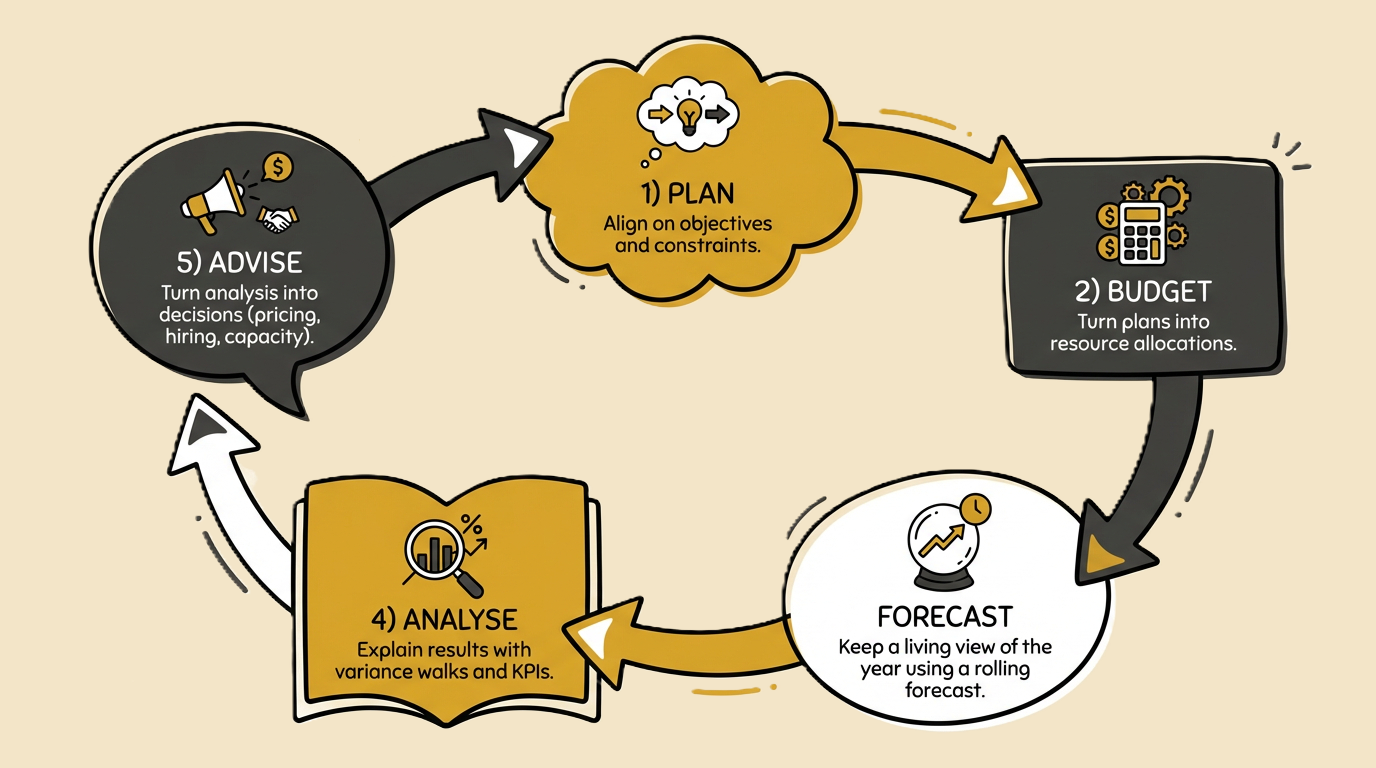
Plan: Align on objectives and constraints.
Budget: Turn plans into resource allocations.
Forecast: Keep a living view of the year using a rolling forecast.
Analyse: Explain results with variance walks and KPIs.
Advise: Turn analysis into decisions (pricing, hiring, capacity).
Iterate: Update assumptions as the business learns.
FP&A data flows from source systems (such as billing, payroll, and CRM) into models and dashboards. Spreadsheets remain common; BI tools help with repeatability and shared truth. The real advantage isn’t the tool, it’s the clarity of assumptions and quality of communication.
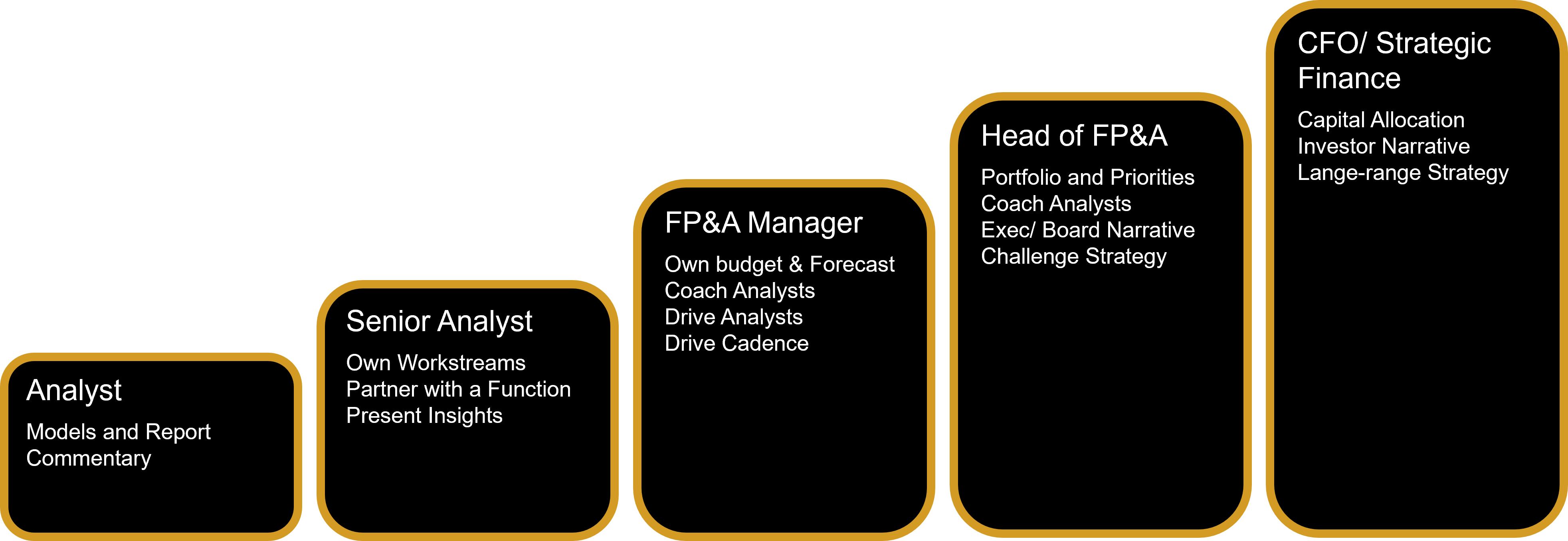
Foundation
Builder
✔ Advanced Excel; basics of SQL / BI tools
✔ Budgeting & rolling forecast cadence
✔ Driver-based modelling & scenario analysis
✔ Stakeholder partnering & presentation
Owner
✔ Owns forecasting cycles & variance narratives
✔ Links insights to action with metrics/OKRs
✔ Guides juniors; improves processes & controls
✔ Partners with Finance/OPS/GTM leaders
Strategic
✔ Strategic planning & portfolio priorities
✔ Board-ready storytelling & investor fluency
✔ Operating model, cadence & talent roadmap
✔ Technology choices (planning, BI, data)
Focus on driver-based modelling and communication early; they compound across every level.
Do I need a CPA or CFA to work in FP&A?
No single credential is mandatory across all roles. CPA/CA helps with accounting fluency and credibility; CFA helps with valuation and capital‑market thinking. Choose based on your target path and market.
How is FP&A different from Finance Business Partnering?
They often overlap. FP&A tends to own the planning/forecasting cadence; Business Partnering embeds closer to a function (e.g., Sales, Operations) to influence day‑to‑day decisions. Many teams combine both.
What makes a “good” forecast?
Assumptions are explicit, drivers are connected to outcomes, and errors are tracked, allowing the forecast to improve over time. It’s less about perfect precision and more about decision usefulness.
Want to see FP&A in action? Read our case study: Unlocking Productivity.